
One of the most common electrical defects that I find when inspecting old houses in the Twin Cities is ungrounded three-prong outlets. This happens when a standard three-prong outlet is wired without the ground wire being connected. Today I’ll give a brief explanation of what the third prong is for, and I’ll discuss a few ways to correct a miswired three-prong outlet. I didn’t consult an attorney before writing this article, so I feel like I should add a disclaimer before giving any electrical how-to advice: Don’t do any of this work if you’re not qualified. This is only an overview.
The third prong on an outlet is commonly referred to as ‘the ground’, and it provides an alternate path for electricity that may stray from an appliance or product. This is an important safety feature that has been required since 1962, which minimizes the risk of electric shock, and allows surge protectors to protect your electrical equipment, such as televisions, computers, stereos, and other devices.
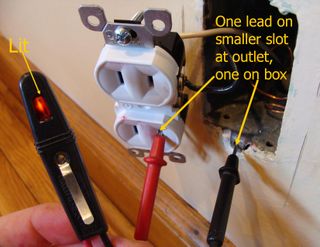
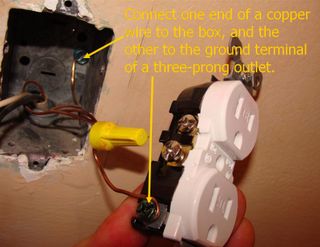
The ideal way to repair an ungrounded three-prong outlet is to establish a continuous electrical path back to the main panel. If the outlet is installed in a metal box, and that metal box has metal conduit all the way back to the panel, this will probably be pretty easy to do. To test this, you can use an inexpensive pig-tail electrical tester. With the circuit energized, touch one end of the tester to the hot wire, which should go to the smaller slot on the outlet, and one end of the tester to the electrical box (see the first photo below). If the tester lights up, the box is grounded. Now all you need to do is attach a bare copper wire to the box, and use this as the ground wire for a three-prong outlet (see lower photo below).
Note: if the electrical box is installed in a concrete block wall, this will provide a ground path for the outlet box, telling the tester the box is grounded. This is not a proper ground path for the outlet. If there are outlets installed in a concrete block wall, my advice would be to bring in an electrician to get to the bottom of how to properly ground the outlets.
If you perform the test with a pig-tail tester and the light doesn’t light up when you touch the hot wire to the box, the box is not grounded (or you’re not touching a hot wire). In this case, you could run a ground wire back to the panel, or you could install a GFCI outlet. A GFCI outlet provides protection against lethal shocks, but without a ground wire, this outlet will not provide any protection for your electrical equipment. A surge protector plugged into an ungrounded outlet will do nothing, and you could fry your new plasma TV. You will need to add a sticker to the GFCI outlet that reads “No Equipment Ground” – this sticker comes with every GFCI outlet.
Reuben Saltzman, Structure Tech Home Inspections – Email – Twin Cities Home Inspector
40 responses to “Ungrounded Three Prong Outlets – How To Fix options-for-repairing-ungrounded-three-prong-outlets/”
No comments yet.
RSS feed for comments on this post.
Comments on posts over 90 days old are disabled, as of 1/7/14.