
One of the must-have home inspection tools everyone on my team uses is a combustible gas detector. Also known as a gas sniffer. We use these to locate suspected gas leaks and combustion gas leaks. My favorite one has been the TIF8900 for a long time, but this model isn’t being made anymore, and some home inspectors on my team have complained about the nickel-cadmium batteries. So I tested a whole bunch of new ones.
To help decide which ones to buy, I looked up the specs on a bunch of models. I ordered the ones that claimed to have instant feedback, or near-instant feedback. Any models that took one second or longer to respond were out of the running. That left me with the models shown below.
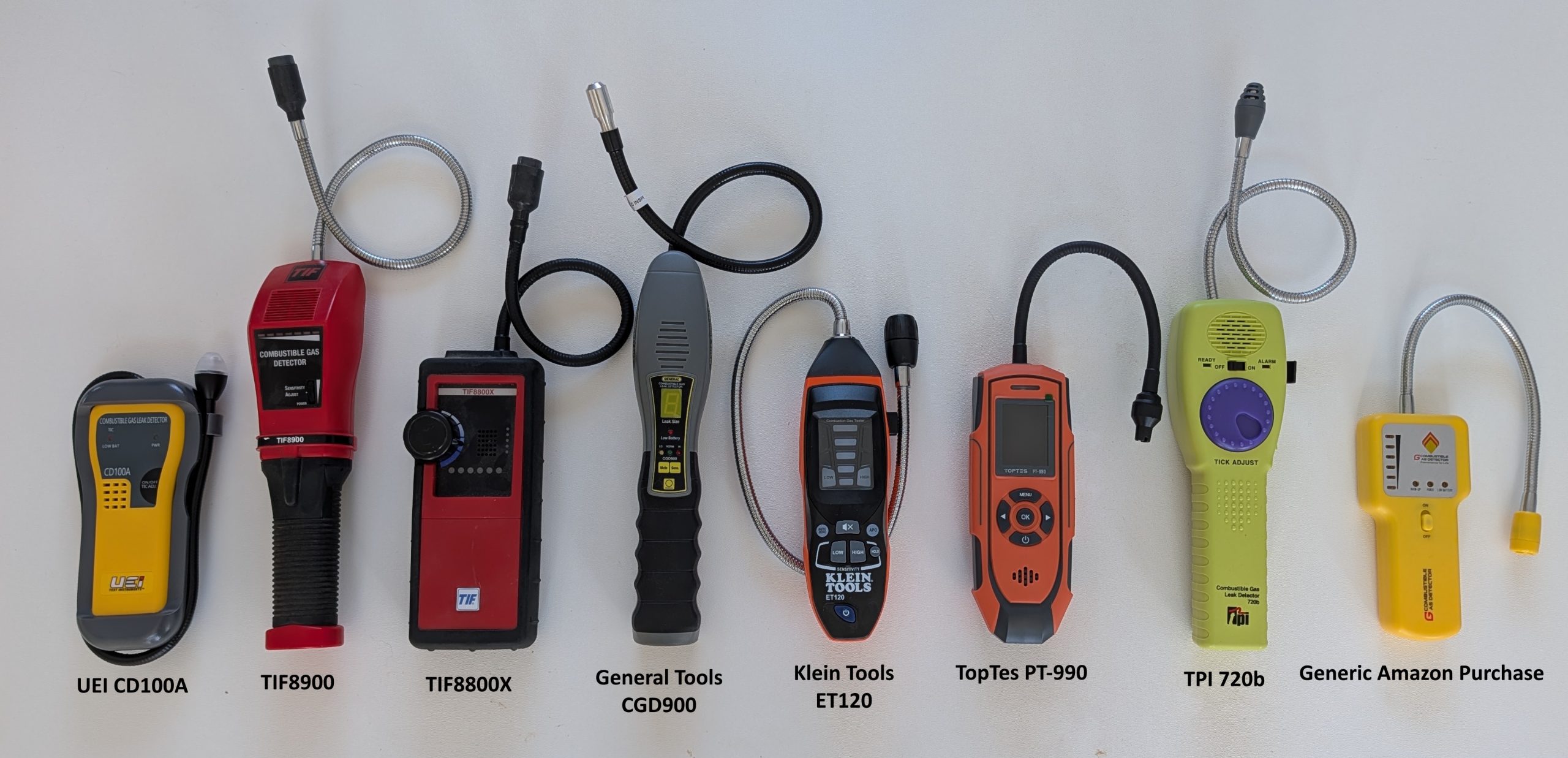
To really appreciate how these perform differently, check out my video above. If you want the summary for each model, read on.
UEI CD100A ($215)
Pros: The wand wraps around the device, making for compact storage. It’s also the only device with a light at the sniffer, which is novel but not particularly useful. Also, it runs off a single 9-volt battery; this is great, because if you have a dead battery, you just swap it for another. Also, the boot-up time was near instantaneous. You simply turn it on, mess with the sensitivity dial until you’re happy, and you’re good to go.
Cons: I didn’t feel completely confident with the results. It wasn’t as responsive as I’d like, and it kept sounding off for a long time even after I had pulled it away from a gas leak. I call this the recovery time. Very long recovery time. This isn’t a bad tool, but there are better options available.
TIF8900 ($400)
Pros: Best overall performance. It’s loud, and I felt completely confident with the results. Feedback is instantaneous, and the recovery time is nearly instantaneous too. This has been the gas detector of choice for the home inspectors at Structure Tech for a long time, and doing this testing helped to reinforce why.
Cons: The TIF8900 runs off a pair of 2.4-volt nickel-cadmium batteries. No joke. They look like C-cell batteries, but they’re not. So if you need to replace the batteries, it’s terribly expensive. Also, if the batteries start running low, the device performs terribly. That’s it. No alerts, just terrible performance. And when you plug the device into the charger, there’s nothing to indicate it’s charging, and it takes a LONG time to charge the batteries. All of this battery nonsense is what led me to shop for a new device.
Also, this device has been discontinued.
TIF8800X ($400)
Pros: Nearly identical performance to the 8900. The only thing I don’t like is that it’s significantly quieter, which is why I’ve preferred the 8900.
Cons: Pretty much the same as the 8900. This takes a proprietary nickel-metal hydride battery back.
General Tools CGD900 ($246)
Pros: It runs off four AA batteries.
Cons: It beeps loudly every second, and it was very slow to detect combustion gases. I couldn’t wait to turn this device off. I do not recommend this tool.
Klein Tools ET120
Pros: It runs off four AAA batteries.
Cons: The start-up time is nearly 60 seconds. It had an extremely slow response and recovery time; surely over 1 second. I couldn’t find the response time listed online, but I gave this sniffer a chance anyway. The response time was so slow that I would surely miss significant gas leaks with this device. Also, it delivered subpar performance in finding exhaust gas leaks. I do not recommend this tool.
TopTes PT-990 ($120)
Pros: USB-C charging port with an internal lithium-ion battery. Color screen with all kinds of menus, options, graphs, everything you could possibly think of and a lot more. It definitely feels like the most modern gas sniffer available.
Cons: The gas sensitivity was over-the-top. I couldn’t get it anywhere close to a gas leak without it sounding off. And the recovery time was far longer than anything else I tested. I’m talking like 10 to 20 seconds. As for combustion gas leaks, it was useless. I stuck it right in the vent for my gas oven and nothing happened. Apparently, it doesn’t detect combustion gas leaks. I do not recommend this tool.
TPI 720b ($160)
Pros: It runs off a pair of C-cell batteries, and you don’t need tools to open the battery compartment. Boot-up time was near instantaneous. The ability to quickly identify gas leaks and recover was almost as good as the TIFs.
Cons: No cons. This is my new favorite combustible gas detector.
Generic Amazon Purchase ($30)
Pros: The price! Come on, this is nearly a disposable tool for $30. And it runs off three AAA batteries. The boot-up time was near instantaneous. And it did a pretty good job of finding gas and exhaust leaks.
Cons: The sensitivity wasn’t great when finding exhaust gas leaks. Also, it seems to have a large gap between finding a leak and not finding a leak. While devices like the TIFs do a great job of letting you know when you’re “close, closer, closer”, this device didn’t have a ramp-up and ramp-down period. It seemed to jump right over that.
While I wasn’t crazy about this device’s performance, I found it adequate. When you couple that with the dirt-cheap price tag, I say this tool delivers great value. This would be a good option for home inspectors who want a backup gas sniffer, or a DIY person who doesn’t want to spend a ton of money on a combustible gas detector.
Jim Weidner
January 22, 2026, 2:24 pm
Thanks for the gas detector comparison video. Of course, I purchased the Klein a while ago and can confirm, it’s a turd. Nice to now have options.